Feiteng Long, Clare Llewellyn, Luke Stephens, Constantine Kyritsopoulos, Laura Cram, Adam Moore
public attitudes
Effective communication on migration means moving beyond uniform messaging to account for the deep-seated factors that shape alignment between narratives and the audience’s pre‑existing worldviews or core beliefs. This is because communication does not impact all citizens equally. Yet, while the volume of migration messaging increases, there is a critical uncertainty gap in how these stories are received and understood by the public.
Messaging that matches the mindset
Our research in the Neuropolitics Lab shows that building common ground means looking beyond the what of the message to the why and how—specifically how information interacts with:
Cognitive bias, meaning how we filter new information through pre-existing beliefs;
Core beliefs, which are the moral and identity frameworks that drive public reception;
Emotional resonance, what our neurophysiological responses and biometric measures can tell us.
A Core belief is an ingrained, fundamental, self-related idea that shapes an individual’s thoughts, feelings, and actions on a particular socio-political issue such as migration, often without realising.
A Frame is designed to influence the perceptions of a reader by selecting aspects of reality, focusing on these aspects to encourage a specific point of view. A narrative frame is designed to expose the reader to a specific contextualisation of an issue.
Psychophysiology focuses on the interrelationship between the mind and the body. Psychological processes such as emotions, thoughts, and behaviours can be revealed by physiological signals in the body, and the measurement of these bodily responses can give insight into internal mental states.
Triggered by narratives
European migration debates are often polarised into narratives of ‘migration as opportunity’ or ‘migration as threat’. Even when a message appears persuasive on the surface, it can trigger underlying physiological stress if it conflicts with a citizen’s core beliefs. Our research explores the psycho-physiological processes through which individuals respond to migration narratives and how such responses relate to attitudes, emotions and behaviour.
We examine both the product and the process of migration narratives. By product, we refer to the consequences of exposure on individuals’ attitudes, towards the migrants themselves and towards the author of the message. By process, we refer to what happens while individuals engage with migration narratives, especially whether such engagement causes stress and, if so, whether that stress is primarily driven by the frame of the narrative or by a match or mismatch between the narrative and individuals’ pre-existing core belief.
When people engage with migration narratives, for example, by reading them, evaluating them, or formulating a response, they may experience stress. Depending on the circumstances, this stress can be relatively benign and mobilising (challenge), but it can become more aversive and defensive (threat).
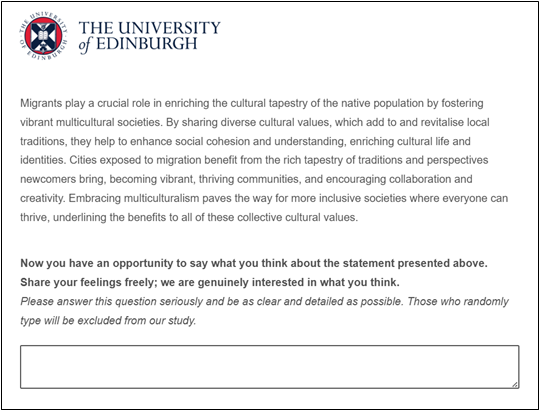
In our study to be launched during the Lunch Bite on 19 October— which combines online experiments across Denmark, Italy, Germany, and Poland alongside lab-based psychophysiological testing— we looked at attitudinal, behavioural and psychophysiological responses to economic and culturally based narratives, framed as either a threat or an opportunity (the image below shows an opportunity narrative).
Key takeaways
-Invisible stress responses: Public communication can generate significant physiological stress, not just through its content, but by challenging an individual’s core political worldviews.
-The persuasion paradox: Messages that participants report as persuasive in surveys may still fail to dampen underlying biological stress, particularly regarding the cultural aspects of migration.
-Benefits of opportunity framing: Narratives portraying migration as an opportunity reduced anxiety, increased excitement, and improved attitudes toward both the migrants and the narrator.
-The power of belief alignment: When a narrative matches a recipient’s pre-existing worldview, they report higher excitement, lower anxiety, and evaluate the narrative source more favorably.
-Cultural sensitivity: Cultural arguments regarding migration are the most sensitive to belief-mismatch, making them high-risk for triggering defensive reactions.
Recommendations for communicators
Pair opportunity-framing with segmentation: While opportunity frames encourage constructive engagement, they must be targeted. Use audience segmentation to ensure these frames do not trigger a threat response or backlash among groups with mismatched core beliefs.
Prioritise messenger credibility over content alone: Recognize that a communicator’s perceived legitimacy is highly contingent on their alignment with the audience’s worldview. Strategic selection of trusted intermediaries and local messengers may be more impactful than the message itself.
Modernise communication evaluation: Move beyond simple opinion polls and self-reporting. Evaluation of migration campaigns should incorporate behavioral and, where possible, physiological indicators to detect hidden stress and latent polarization risks that surveys might miss.
Acknowledge core-belief sensitivity: In policy design and rollout, explicitly account for how narratives can be perceived as a threat to identity. Avoid one-size-fits-all rhetoric that ignores the diverse psychological starting points of the citizenry.
Feiteng Long is a Postdoctoral Research Fellow at the Neuropolitics Research Lab of the University of Edinburgh. His research explores the social and psychological processes behind intergroup relations and social change.
Clare Llewellyn is a Senior Lecturer in Governance, Technology, and Data, and an expert in computationnal social science and the analysis of social media.
Luke Stephens is a doctoral researcher at the Neuropolitics Research Lab. His research explores the use of Large Language Models (LLMs) to extract and interpret political narratives from texts.
Constantine Kyritsopoulos is a doctoral researcher at the Neuropolitics Lab. His research focuses on the psychology of identity, ideology, and values within political contexts, combining behavioral experiments with quantitative survey methods.
Laura Cram is Professor of European Politics as well as the Director of NRLabs Neuropolitics Research, School of Social and Political Science (University of Edinburgh).
Adam Moore is a Lecturer in the School of Philosophy, Psychology and Language Science. Adam’s research explores the complex relationship between morality, power, and politics.
We use cookies to help personalise content and provide a better experience. By clicking Accept all, you agree to this, as outlined in our Cookie Policy. To change preferences or withdraw consent, please update your Cookie Preferences.