LSP is a forward-looking, participatory method that facilitates open communication and effective collaboration. Using LEGO® bricks, participants build ideas, concepts, and visions before reflecting on them. They “think with their hands”: every idea must be built before it is discussed. This approach is said to “lead to a deeper and more reflective engagement”.
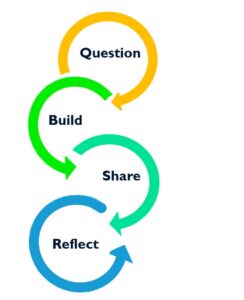
1. The question: A facilitator presents a building prompt.
2. Building: Participants use LEGO® bricks to build their answer (the bricks/models being metaphors).
3. Sharing: Each person explains the meaning behind what they built (storytelling).
4. Reflection: The group reflects on the story and its meaning.
These cycles are first completed individually, before creating a shared vision as a group. When participants disagree on ideas, they discuss and negotiate until everyone feels represented and can accept the shared model.
How we used LEGO® Serious Play® for migration preparedness
During the workshop, we invited participants to step away from notebooks and pencils and instead use their hands to build what migration preparedness means to them.
Led by a certified LSP facilitator, Prof. Birte Nienaber, with previous experience using LSP in migration research, this was the first time the method was applied in an EMN Luxembourg event.
Over four hours, our 24 participants, including forecasting experts, reception staff, government officials, EU agency representatives, and civil society members, worked in two teams inside an imagined EU Member State calledINNOVATIA.
The participants:
– Built individual models of how preparedness could be strengthened at the personal, civil-society, and state level.
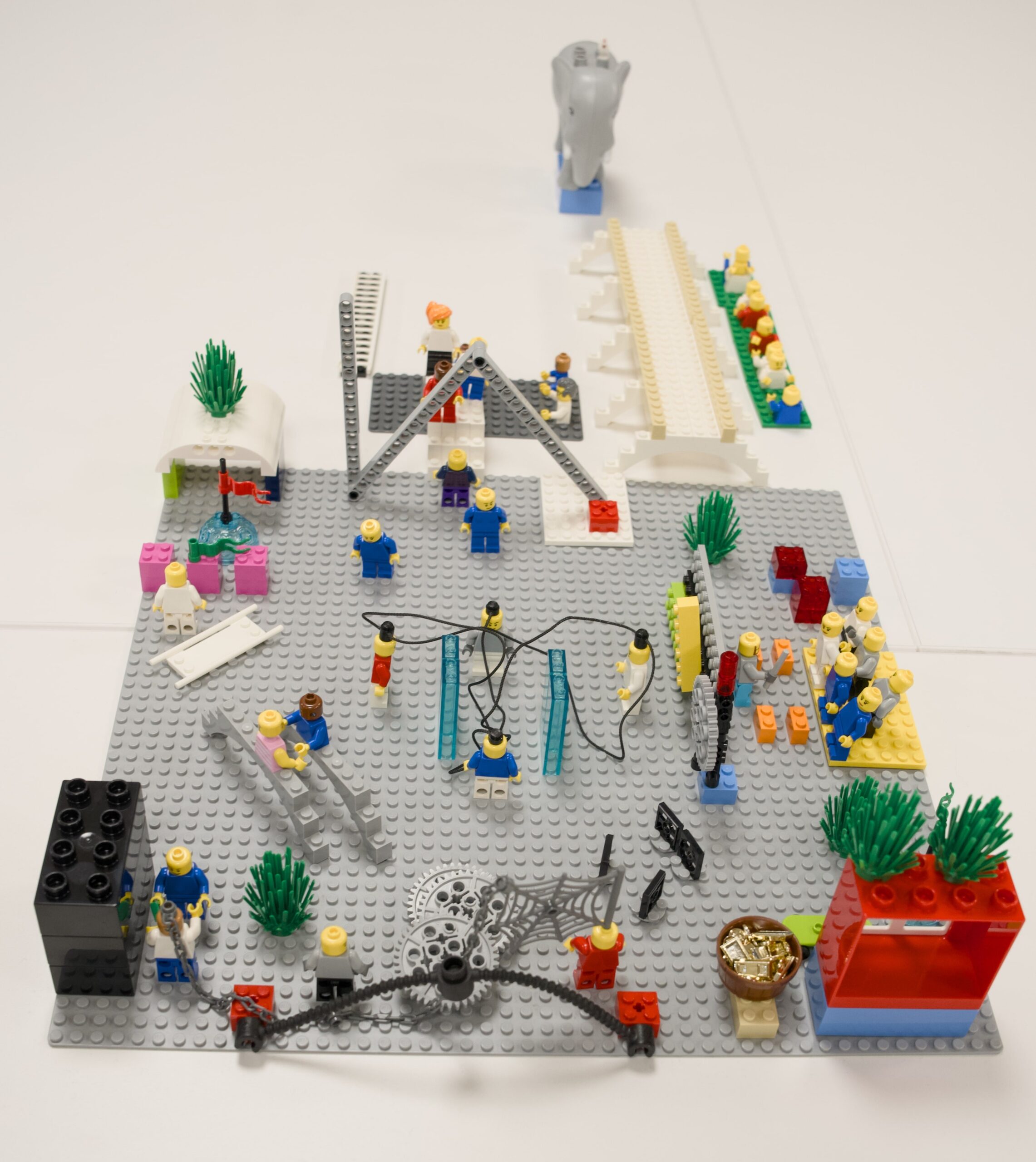
– Created a shared vision of preparedness, discussing what to include to find common ground (see figure 2).
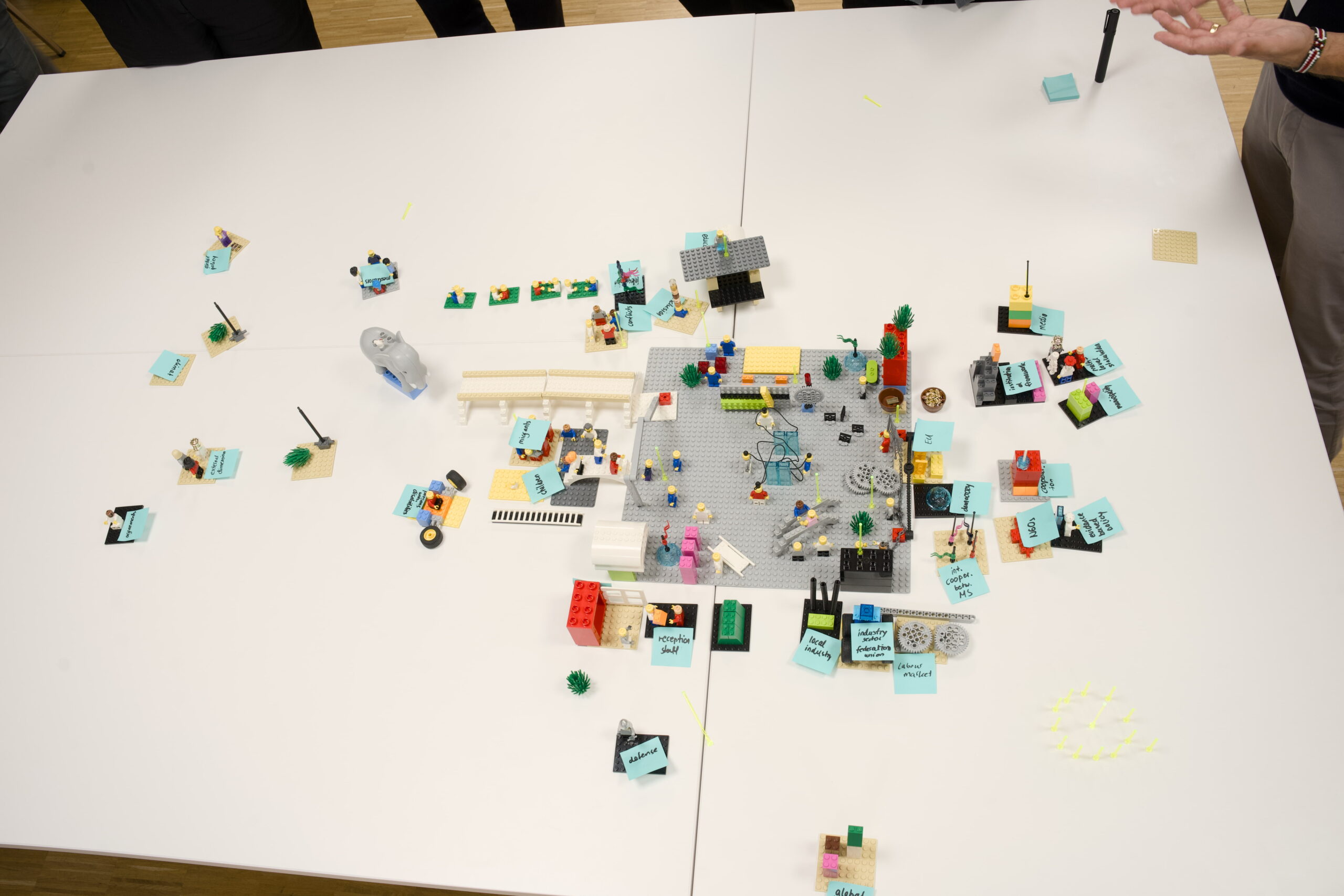
– Built key actors and trends impacting preparedness, positioning each by its level of influence on INNOVATIA’s preparedness (see figure 3).
– Stress-tested the preparedness model with a scenario of an unexpected, large-scale influx of migrants from North America, identifying potential weaknesses and how impact might unfold (see figure 3).
– Brainstormed actions that should and could be taken today to boost preparedness.
– Agreed on five priorities for better preparedness starting today.
Figure 2: Shared model of preparedness of group A, showing how to increase preparedness on the individual, civil society, and state level.
Figure 3: Shared preparedness model of group A at later stage, showing the trends and actors influencing preparedness of their model.
Why LEGO® Serious Play® worked well for migration preparedness:
Engaging with complex topics: Through LSP, the complexities, connections, and intangible factors (such as, for instance, public opinion or political commitment) were made visible, making it easier to pinpoint challenges.
Reducing power dynamics: LSP’s approach can reduce power dynamics that arise in group settings. We also skipped formal introductions, so no one knew each other’s roles or titles, further softening hierarchical dynamics. Together, this created an environment where everyone could contribute on a more equal footing.
Co-creating knowledge: Everyone was required to participate and share their ideas, which allowed us to draw on participants’ diverse professional backgrounds. This resulted not only in more holistic knowledge creation, but also greater ownership of all participants in the outcomes.
Enabling constructive dialogue: Migration topics can be polarizing, and participants did not agree on all aspects, such border management. LSP’s playful nature made sensitive topics easier to discuss constructively, creating space for more open conversation.
By the end, each team had co-created a preparedness vision that reflected the diverse perspectives of researchers, policy actors, and practitioners.
Participants’ take-away:
As one participant put it, there was more than one unexpected takeaway, as “it was very dynamic and interactive, and we moved constantly around the tables […]. We were very much more focused on ideas rather than on words […]. And I think you remember the ideas of the other interactive players very well because you have seen them [three-dimensionally]”. Listen to some of participants’ takeaways in our event after-movie.
Are you ready to give LEGO Serious Play a try? Start by:
-Think of scenarios that could challenge the resilience of existing policies, societies, communities, or situations, and that LSP may be useful to engage on.
-Learn more about how the method can support your objectives.
-Reach out to a certified LSP facilitator to help set-up and run your session.
Birte Nienaberis an Associate Professor in Political Geography at the University of Luxembourg. She is a certified LEGO® Serious Play® facilitator and has extensive experience in participatory research methods. She has been using LSP as a research method in migration studies, for instance, to research the needs of young migrants in vulnerable conditions during the Horizon Europe project MIMY. She coordinates the National Contact Point Luxembourg of the European Migration Network (EMN Luxembourg) and the European Union Agency for Fundamental Rights (FRANET), as well as the Horizon Europe project INNOVATE at the University of Luxembourg. Previously, she was the coordinator of the Horizon Europe projects MIMY and MOVE.
Nora Trauschis a Research and Development Specialist at the University of Luxembourg, where she is working on the EU Horizon project INNOVATE.
Jutta Bissinger is a Research and Development Specialist at the University of Luxembourg, where she has worked on several EU Horizon projects in the field of migration and asylum, among others MIMY, MOVE, and INNOVATE.
We use cookies to help personalise content and provide a better experience. By clicking Accept all, you agree to this, as outlined in our Cookie Policy. To change preferences or withdraw consent, please update your Cookie Preferences.